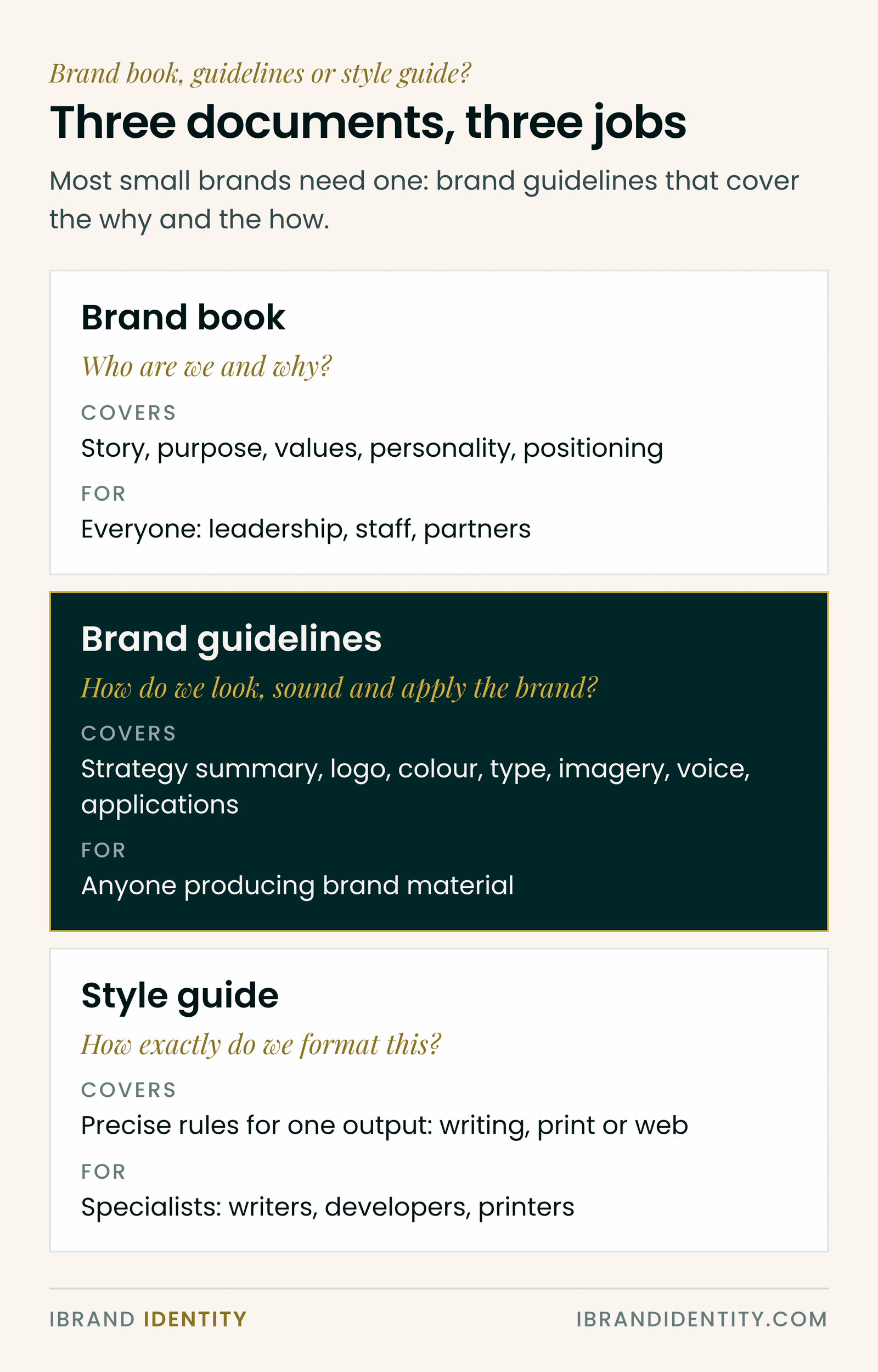
Short answer: brand guidelines, a style guide and a brand book overlap, and people use the terms loosely. In common use, a brand book explains who the brand is: its story, values and personality. A style guide sets precise rules for one kind of output, such as writing, print or a website. Brand guidelines sit in the middle and usually cover both: the strategy in brief, then the visual and verbal rules for using the brand. For most small and mid-sized businesses, one well-made brand guidelines document does all three jobs.
Key takeaways
- There is no official standard for these terms. Agree what the document must do before arguing about its name.
- Brand book = why. Style guide = exactly how, for one output. Brand guidelines = why and how, for everything.
- Most small brands need one document: brand guidelines with the strategy at the front.
- Larger organisations often split it: a short brand book for everyone, guidelines for brand users, detailed style guides for specialist teams.
- Whatever you call it, it needs an owner and a date, or it goes out of date.
Brand guidelines vs style guide vs brand book at a glance
| Brand book | Brand guidelines | Style guide | |
|---|---|---|---|
| Main question it answers | Who are we and why? | How do we look, sound and apply the brand? | How exactly do we format this? |
| Typical content | Story, purpose, values, personality, positioning | Strategy summary plus logo, colour, type, imagery, voice and applications | Precise rules: type sizes, spacing, colour codes, grammar, UI components |
| Main audience | Leadership, staff, partners | Designers, marketers, agencies, anyone producing brand material | The people producing one kind of output, such as writers or developers |
| Tone | Inspiring | Practical, with reasons | Technical |
| Typical length | Short: 10 to 30 pages | 15 to 70 pages, depending on the project | Varies; often a living document or web page |
You’ll also hear brand bible, brand manual, brand standards and brand identity guidelines. These are usually other names for brand guidelines, sometimes with a slightly different emphasis.
What is a brand book?
A brand book tells the story of the brand. It covers why the business exists, what it believes, who it serves, how it is different and what it feels like. It is often designed to be read rather than consulted: something to give a new employee on their first day, or to share with partners so they understand the brand before they work with it.
Some agencies use “brand book” for the whole guidelines document. That’s fine, as long as everyone knows what’s inside.
What are brand guidelines?
Brand guidelines are the working rulebook for the brand. Good ones start with a short version of the strategy (story, audience, positioning, values, personality, messages and voice) and then set out the visual system: logo, colour, typography, imagery and design elements, followed by examples on real applications. Our checklist of what to include in brand guidelines breaks this into 13 sections.
The strategy pages matter. Visual rules on their own tell people what to do; the strategy tells them why, so they can make good decisions the document never covered.
What is a style guide?
A style guide gives precise rules for producing one kind of output. Common types:
- Editorial or writing style guide: grammar, spelling, punctuation, capitalisation, words to use and avoid.
- Visual or print style guide: exact type sizes, grids, margins and colour specs for printed materials.
- Web or UI style guide: buttons, forms, spacing and components, often built into a design system.
In some industries “style guide” is used for the whole brand guidelines document. In others, it means only the writing rules. Ask which one is meant before you quote for it.
Which one do you need?
A small business or a single brand
One brand guidelines document, 15 to 30 pages, with the strategy at the front and the visual and verbal rules after it. It does the job of all three. If you’re documenting your own brand, start with our free brand guidelines template.
A growing company with an in-house team or agencies
Fuller brand guidelines, with more applications and clearer approval rules, plus a short writing style guide if several people write for the brand.
A larger organisation
Often three layers: a short brand book everyone reads, brand guidelines for the people who produce brand material, and specialist style guides or a design system for writers, developers and print teams. Keep them consistent by making the brand guidelines the source the others refer to.
For designers: what to call it in your proposal
- Describe the contents, not just the name. “Brand guidelines (around 30 pages): strategy summary, logo, colour, typography, imagery, voice and five applications” leaves no room for confusion.
- Say what’s not included. A full editorial style guide or a UI component library is a separate piece of work.
- Agree the format: PDF, editable source files, a web page, or all three.
- Name who owns it after handover, and whether you’ll be asked to update it.
Common mistakes
- Arguing about the name instead of the job. Start from who will use the document and what they need to decide.
- A brand book with no rules. Inspiring, but people still don’t know which logo to use on a dark background.
- A style guide with no reasons. Rules without the strategy behind them get followed for a few months, then ignored.
- Three documents that disagree. If you split them, make one the source of truth.
A template that covers all three
Our Brand Guidelines Template for designers ($49) is built as one document that does all three jobs: 66 pages in 13 sections, with the strategy pages first (introduction, values, personality, audience, positioning and key messages), then the logo system, colour, typography, imagery, design elements, voice and applications. It comes in InDesign, Illustrator and PDF, in 16:9, A4 and US Letter, so you can delete the sections a project doesn’t need.
Frequently asked questions
What is the difference between brand guidelines and a style guide?
Brand guidelines usually cover the brand as a whole: a summary of the strategy plus the rules for logo, colour, typography, imagery, voice and applications. A style guide usually sets precise rules for one kind of output, such as writing or a website. The terms are often used interchangeably, so check what is meant.
Is a brand book the same as brand guidelines?
Not always. A brand book often focuses on the story, values and personality of the brand, while brand guidelines add the practical rules for using it. Some agencies use brand book to mean the whole guidelines document.
What is a brand bible?
Brand bible is another name for brand guidelines or a brand book, usually suggesting a complete reference that covers both the strategy and the rules.
Does a small business need a brand book and a style guide?
Usually not. One brand guidelines document with the strategy at the front and clear visual and verbal rules does the job for most small businesses. Separate documents make sense once several teams or agencies produce brand material.
What should a brand style guide include?
It depends on the type. A writing style guide covers grammar, spelling, tone and word choices. A visual style guide covers exact type sizes, grids, spacing and colour specifications. A web style guide covers interface components such as buttons and forms.
How long should brand guidelines be?
Long enough to answer the questions people actually ask. For most small and mid-sized brands that is 15 to 30 pages; full identity systems for larger organisations often run to 60 pages or more.
Written by Martina Boshra, founder of iBrand Identity and creator of The Transmutation Method™. Brand strategist for founders and service businesses across the US, Europe and the Gulf. Part of the brand identity process guide. Last updated November 2026.