Short answer: a brand identity project has three phases: discover, present and hand over. In discovery you and the client agree the strategy and get it signed off. In the presentation you show identity directions against that strategy, so the client judges ideas rather than taste. At handover you give the client brand guidelines that explain the decisions, so the identity stays consistent after you leave. This guide walks through each phase, what to make, and the mistakes that cost designers rounds of revisions.
Key takeaways
- Get the strategy signed off in writing before you design anything. It becomes the brief every concept is judged against.
- Open the presentation with the strategy, not the logo. A logo shown first gets a reaction to taste.
- Show three directions, each with the idea, the logo, colour and type, and the brand in use.
- Put the strategy pages at the front of the guidelines. People follow rules they understand.
- Use one structure on every project. A repeatable process is what lets you raise your prices.
What is the brand identity process?
The brand identity process is the order of work a designer follows to take a client from a first conversation to a finished, documented identity. Most processes share the same three phases, even if studios name them differently:
- Discover: learn the business, run a strategy session and write a strategy the client signs.
- Present: design identity directions and present them against the agreed strategy.
- Hand over: document the chosen identity in brand guidelines and walk the client through them.
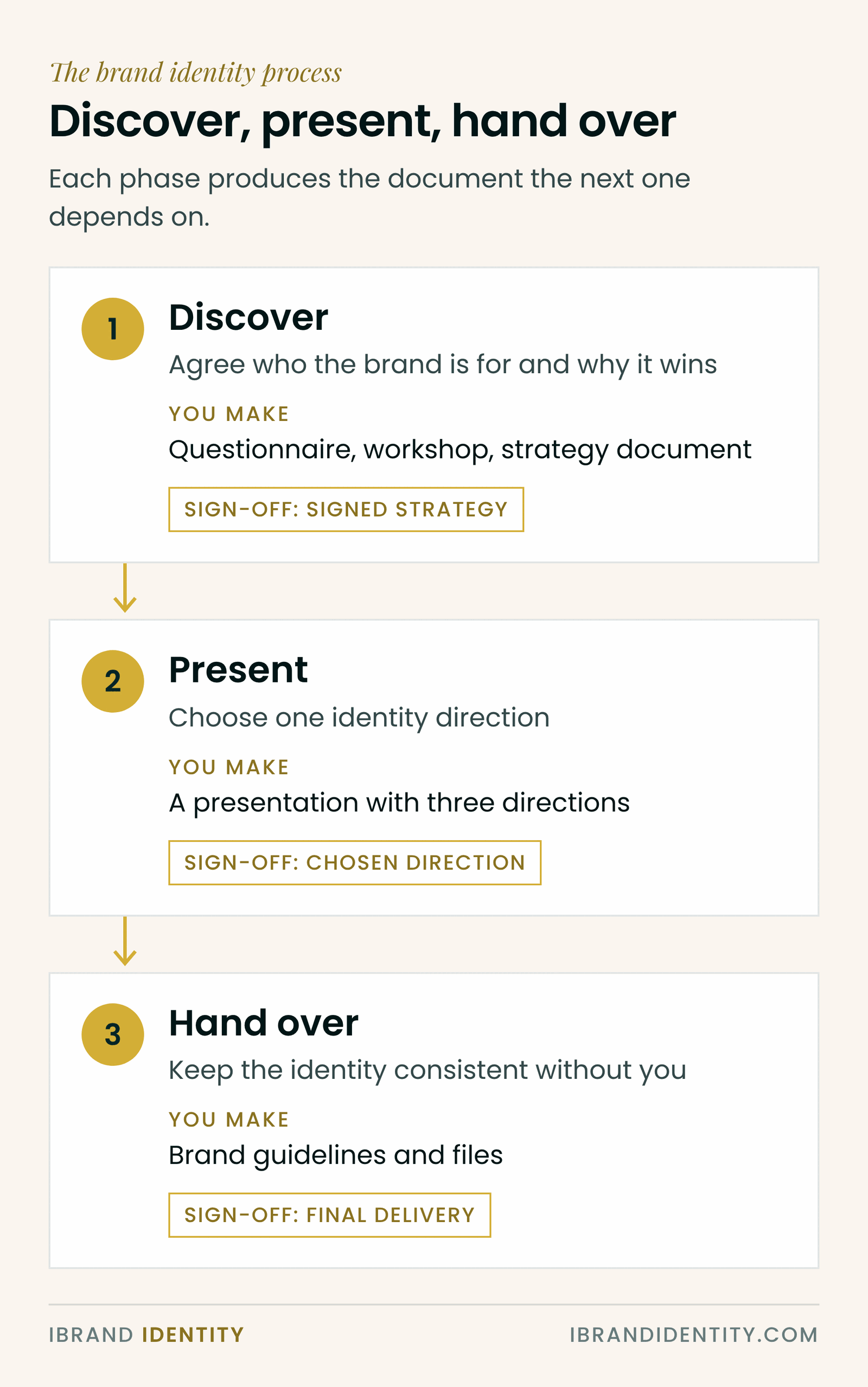
Each phase produces one document the next phase depends on. A questionnaire and workshop produce the strategy, the strategy is the brief for the presentation, and the chosen direction becomes the guidelines. Skipping a document is where projects go wrong: no signed strategy means concepts get judged on personal taste, and no guidelines means the identity drifts within months.
The process at a glance
| Phase | Goal | What you make | Sign-off |
|---|---|---|---|
| 1. Discover | Agree who the brand is for and why it wins | Questionnaire, workshop, strategy document | Signed strategy |
| 2. Present | Choose one identity direction | Brand presentation with three directions | Chosen direction |
| 3. Hand over | Keep the identity consistent without you | Brand guidelines and files | Final delivery |
Phase 1: Discover
Discovery is where you earn the right to design. Its job is to turn what the client knows about their business into a strategy both of you agree on: who the brand is for, who it competes with, what it stands for and how it should sound.
1. Send a questionnaire before you meet
Ask the client to answer in writing first, so the session starts from their words rather than a blank page. Explain why you ask each question; clients give better answers when they know what the answer is for. Our free branding questionnaire has 28 questions you can send as they are. For 30 questions written for designers to send clients, with what each group is for, see brand discovery questions.
2. Run a strategy workshop
Work through audience, competitors, positioning and personality together, with time boxes so the session ends with decisions, not notes. Three hours is enough for a small business if every exercise has a clear output.
3. Write the strategy while it’s fresh
Turn the session into a short strategy document within a few days: insights, audience, positioning, values, voice and key messages. If you need a structure, start from our free brand strategy template and the positioning statement worksheet.
4. Get it signed off
End the document with a sign-off page. Once the client signs, the strategy is the brief, and every concept in Phase 2 is judged against it instead of against personal taste.
Do it faster: the Brand Discovery & Strategy Kit ($69) packages this phase: a 45-question client questionnaire in eight parts, 18 workshop slides for a three-hour session with eight exercises, a 22-slide strategy document written out as a worked example with a sign-off page, and an 8-page session guide with three email templates. PowerPoint and Word, with fillable PDFs in A4 and US Letter.
Phase 2: Present
The presentation decides whether your best idea gets approved or picked apart. The rule that matters most: show the thinking before the logo. A logo on its own invites a reaction to taste. The same logo after the strategy invites a judgement against the brief.
The order that gets concepts approved
- Recap the brief: what you heard, a quote from the founder, and the success criteria.
- Recap the strategy: audience, positioning, values and personality, exactly as signed.
- Show the directions: an overview of all three, then each in depth.
- Compare and recommend: put the directions side by side and say which you would choose and why.
- Close with next steps: the decision you need, feedback questions and the timeline.
How many concepts should you show?
Three is the common choice: enough to give the client a real choice, few enough that each direction gets proper attention. Give each direction the same four slides (the idea, the logo, colour and type, and the brand in use on real touchpoints) so the client compares ideas, not how much effort each one got.
For the full meeting, from the questions to ask to handling “I don’t like it”, read how to present a logo to a client.
Do it faster: the Brand Presentation Template ($39) follows this order: 32 slides in five sections, three logo directions with four slides each, a comparison and recommendation slide, and presenter notes on every slide. PowerPoint, Keynote and Google Slides.
Phase 3: Hand over
An identity without guidelines starts to drift the day you hand it over. Guidelines are how the client’s team, printers and future designers keep it consistent without calling you.
What client-ready guidelines include
- Strategy first: introduction, audience, positioning, values, personality and key messages, carried over from Phase 1.
- Logo system: the logo family, clear space, minimum size, backgrounds and misuse.
- Colour and type: the palette with proportions and codes, and a full type hierarchy.
- Imagery and design elements: photography direction, patterns and icons.
- Voice and applications: how the brand writes, and the brand on real touchpoints.
For the full section-by-section list, with exact logo, colour and type rules, see what to include in brand guidelines. For what great guidelines look like in practice, see our 10 brand guidelines examples. If the brand is your own and small, the free brand guidelines template (17 slides) is enough.
Walk the client through them
Present the guidelines in a short session instead of sending a PDF. Ten minutes on why the rules exist does more for consistency than any page of do’s and don’ts.
Do it faster: the Brand Guidelines Template for designers ($49) is a 66-page system in 13 sections, strategy pages first, in InDesign, Illustrator and PDF, at 16:9, A4 and US Letter with 3 mm bleed. Linked logos, swatches and paragraph styles mean you edit once and the whole book follows.
Common mistakes
- Designing before the strategy is signed. Every concept round then becomes a debate about taste.
- Leading with the logo. The client reacts before they understand the idea.
- Uneven concepts. A favourite direction with six slides and two others with one each reads as a forced choice.
- Guidelines as an afterthought. A logo sheet is not a handover. The strategy pages are what stop the identity drifting.
- A new process for every client. Reusing one structure saves days and makes your work look more senior.
Where this process comes from
This is the process Martina Boshra uses on client projects at iBrand Identity, including the brand strategy and identity for KEMET Reisen, a German-speaking tour operator for Egypt. The three templates above are that process packaged for designers, all shown with the same fictional demo brand, MAISON AUREL, so you can see each phase finished before you start. See all three in the shop.
Frequently asked questions
What are the steps in the brand identity process?
The brand identity process has three phases. Discover: send a questionnaire, run a strategy workshop, write the strategy and get it signed. Present: show identity directions against that strategy, usually three, and agree one. Hand over: document the chosen identity in brand guidelines and walk the client through them.
How long does a brand identity project take?
For a small business, a typical project runs four to eight weeks: about one to two weeks for discovery and strategy, two to three weeks for design and the presentation, and one to two weeks for refinements and guidelines. Client feedback time is usually what stretches it.
How many logo concepts should a designer present?
Three is the common choice. It gives the client a real choice without spreading your time too thin. Present each direction with the same depth (the idea, the logo, colour and type, and the brand in use) and finish with your recommendation.
What should a brand presentation include?
A brand presentation should recap the brief and the agreed strategy, tell the story behind each concept, reveal the identity, show it on real touchpoints and close with next steps and the decision you need. Showing the strategy first means the client judges the logo against the brief rather than personal taste.
What should brand guidelines include?
Client-ready brand guidelines include the strategy (audience, positioning, values, personality and key messages), the logo system and misuse rules, colour with codes and proportions, typography, imagery direction, design elements, voice and real applications. Small brands can manage with 15 to 30 pages; full identity systems often run to 60 or more.
Are there templates for the brand identity process?
Yes. iBrand Identity sells three templates that follow this process: the Brand Discovery & Strategy Kit ($69) for discovery, the Brand Presentation Template ($39) for the concept reveal, and the Brand Guidelines Template for designers ($49) for handover. Free versions of a branding questionnaire and a brand guidelines template are also available.
Written by Martina Boshra, founder of iBrand Identity and creator of The Transmutation Method™. Brand strategist for founders and service businesses across the US, Europe and the Gulf. Last updated November 2026.