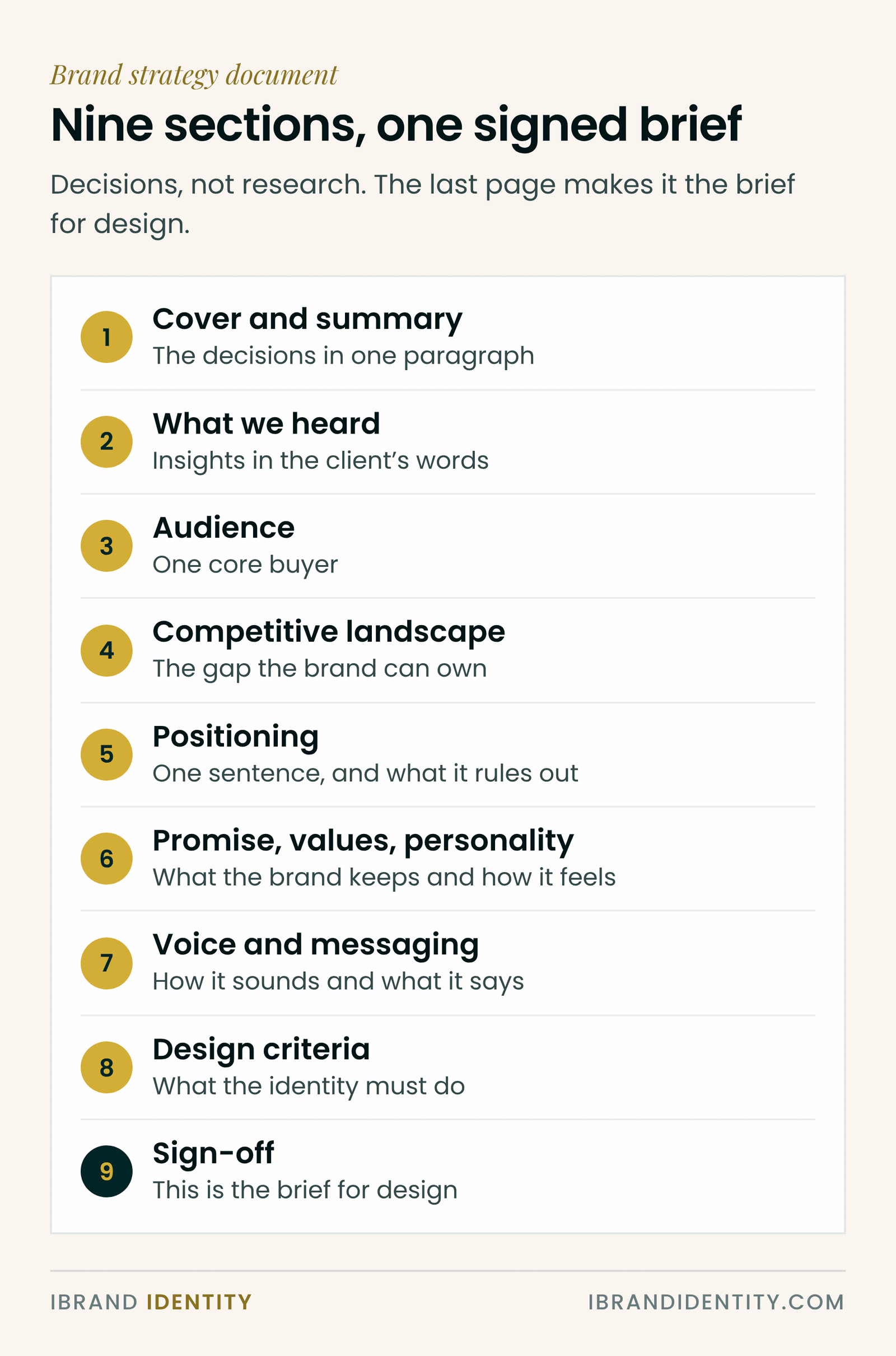
Short answer: a brand strategy document turns what you learned in discovery into decisions the client signs before design starts. Write it within a few days of the workshop. Cover what you heard, the audience, the competitive landscape, positioning, promise and values, personality, voice and key messages, then translate those into design criteria and end with a sign-off page. Keep each section to one idea per page. The signed document becomes the brief every identity concept is judged against.
Key takeaways
- Write it fast. Within a few days of the workshop, while the client’s words are still fresh.
- Decisions, not research. Put findings in an appendix; the main pages state what the brand will do.
- Use the client’s language. Quotes from the questionnaire make the strategy feel like theirs.
- Add design criteria. A strategy that never says what the identity must do leaves the concepts open to taste.
- End with a sign-off page, and don’t start design until it’s signed.
What is a brand strategy document?
A brand strategy document is the deliverable at the end of the discovery phase of the brand identity process. It records who the brand is for, how it is different, what it stands for and how it should sound, in a form the client can read, agree with and sign.
It is not a research report. Research explains what you found; the strategy document says what you decided because of it. If the client finishes reading and can’t say in one sentence what the brand stands for, the document isn’t finished.
What goes in a brand strategy document
| Section | Pages or slides | What it says |
|---|---|---|
| 1. Cover and summary | 1 to 2 | The project, the date and a one-paragraph summary of the decisions. |
| 2. What we heard | 2 to 3 | Insights from the questionnaire and workshop, in the client’s own words. |
| 3. Audience | 2 to 3 | The core buyer: situation, goal, fear, where they look. |
| 4. Competitive landscape | 1 to 2 | The alternatives, the patterns they share and the gap the brand can own. |
| 5. Positioning | 1 to 2 | The positioning statement and what it rules out. |
| 6. Promise, values and personality | 2 to 3 | One promise, three to five values, personality as is / is not. |
| 7. Voice and messaging | 2 to 4 | Tone rules, a core message, supporting messages with proof. |
| 8. What it means for the identity | 1 to 2 | The design criteria the concepts will be judged against. |
| 9. Sign-off | 1 | Names, date and a line confirming this is the brief for design. |
That comes to roughly 15 to 25 pages or slides. Small projects can do it in fewer; the order matters more than the length.
Section by section
1. Cover and summary
Open with the decisions, not the method. One paragraph: who the brand is for, the position it will own and how it should feel. Busy founders often read only this page, so make it stand on its own.
2. What we heard
Three to six insights from the questionnaire and workshop, each with a short quote. This is where the client recognises their own thinking, which makes the rest of the document easier to agree with. Our guide to brand discovery questions covers how to collect them.
3. Audience
One core buyer described in enough detail to design for: their situation, the result they want, what almost stops them buying, and where they look for options. Secondary audiences can follow, but the core buyer gets the space.
4. Competitive landscape
Name the three to five alternatives the buyer compares, including doing nothing. Show the patterns they share visually and verbally, and the gap. A simple two-axis map from the workshop works well here.
5. Positioning
The positioning statement on its own page, large. Underneath, one line on what it rules out. For formats and tests, see our brand positioning statement template.
6. Promise, values and personality
One promise the brand keeps for every client. Three to five values, each with what it means in practice. Personality as pairs (confident, not loud) or as positions on sliders agreed in the workshop.
7. Voice and messaging
Tone rules, words to use and avoid, then the message hierarchy: one core message and three supporting messages, each with the proof behind it. Add a before-and-after rewrite of one real sentence from the client’s current website; it shows the voice better than any adjective.
8. What it means for the identity
The section most strategy documents skip. Translate the strategy into three to five design criteria, such as “must feel established enough for corporate buyers” or “must stand apart from the navy-and-grey category”. These become the success criteria in the brand identity presentation.
9. Sign-off
A page with the names of the decision-makers, the date, and one sentence: “We agree this strategy is the brief for the brand identity.” A signature, a typed name in reply to an email, or an e-signature all work. What matters is that it’s recorded.
How to write it well
- One idea per page or slide. Strategy documents get skimmed; headlines should carry the argument on their own.
- Headlines that state the decision, such as “We are the specialist, not the generalist”, rather than labels like “Positioning”.
- Cut anything that doesn’t change a decision. Interesting research belongs in an appendix.
- Slides or a document? Slides are easier to present and to read on screen; a document is easier to annotate. Most designers present slides and send a PDF.
- Present it before you send it. Walk the client through it in a short call, then send the PDF for signature.
Getting it signed
- Present it live, in 30 to 45 minutes. Pause after positioning and after the design criteria to check agreement.
- Collect changes in one round. Ask for all feedback by a set date, then update once.
- Send the final version with the sign-off page and a clear line: design starts when this is signed.
- Refer back to it. Open the concept presentation with it, and carry it into the guidelines, so the client sees it was worth signing.
Common mistakes
- A research dump. Forty pages of findings and no decisions.
- Values nobody would disagree with. Quality, integrity and innovation describe every business.
- No design criteria. The concepts then get judged on taste.
- Writing it weeks later. The details fade and the client’s momentum goes with them.
- Skipping the signature. Without it, every decision is open again in the concept round.
A ready-made strategy document
Our Brand Discovery & Strategy Kit ($69) includes a 22-slide strategy document written out as a worked example for a fictional brand, so you can see every section finished before you replace a word: insights, audience, positioning, values, voice, messaging and a sign-off page. It comes with the 45-question client questionnaire, 18 workshop slides for a three-hour session, and an 8-page session guide with three email templates.
If you’re working on your own brand rather than a client’s, our free brand strategy template gives you a nine-part structure to fill in.
Frequently asked questions
What should a brand strategy document include?
A summary, insights from discovery, the core audience, the competitive landscape, the positioning statement, the brand promise, values and personality, voice and key messages, design criteria for the identity, and a sign-off page.
How long should a brand strategy document be?
Roughly 15 to 25 pages or slides for most small and mid-sized brands. It should be short enough to present in under an hour, with any detailed research moved to an appendix.
What is the difference between a brand strategy and a creative brief?
The brand strategy records the decisions about audience, positioning, personality and messaging. The creative brief tells the designer what the identity must do. A good strategy document includes the brief as its design criteria section, so one signed document does both jobs.
How soon after the workshop should I write the strategy?
Within a few days. The client’s words and the reasons behind each decision are fresh, and a quick turnaround keeps the project’s momentum.
Should a brand strategy document be slides or a written document?
Either works. Slides are easier to present and read on screen, so many designers present slides and send a PDF for signature. What matters more is one idea per page and headlines that state the decision.
Why get the brand strategy signed?
A signed strategy becomes the brief for the identity. It lets you judge concepts against agreed criteria rather than personal taste, and it protects the project from decisions being reopened later.
Written by Martina Boshra, founder of iBrand Identity and creator of The Transmutation Method™. Brand strategist for founders and service businesses across the US, Europe and the Gulf. Part of the brand identity process guide. Last updated November 2026.