Short answer: a brand discovery workshop is a three-hour working session where designer and client turn the questionnaire answers into strategic decisions. Run it in this order: questionnaire highlights, audience, competitors, positioning, promise, personality, voice and key messages. Give every exercise a time box, write decisions down as you go, and end by reading them back. Within a few days, turn them into a strategy document the client signs before any design starts.
Key takeaways
- Send the questionnaire first. The workshop should start from the client’s written answers, not a blank page.
- Three hours with a break is enough for most small and mid-sized brands. Longer sessions lose energy.
- Get every decision-maker in the room. A strategy agreed without the person who signs it off isn’t agreed.
- Work in exercises with outputs, not open discussion. Each exercise should leave something on the wall.
- End with a read-back of decisions and a date for the strategy document.
What is a brand discovery workshop?
A brand discovery workshop is the meeting at the heart of the discovery phase of the brand identity process. Before it, the client answers a written questionnaire. During it, you work through structured exercises together to agree who the brand is for, what makes it different and how it should sound. After it, you write those decisions into a strategy document.
It is not a presentation and not a brainstorm. You facilitate; the client decides. Your job is to ask the second question, notice contradictions and keep the session moving towards choices.
Before the workshop
- Send the questionnaire one to two weeks ahead, with a deadline a few days before the session. Our guide to brand discovery questions lists 30 to start from.
- Read every answer and highlight the client’s strongest phrases, the gaps and the places where answers disagree.
- Scan the competitors they named, and any they didn’t. Bring screenshots of their homepages.
- Confirm who attends. The founder or final approver must be there. Two to five people is ideal.
- Prepare the room or the board: printed canvases or a shared whiteboard, sticky notes, a timer and someone to take notes if you can.
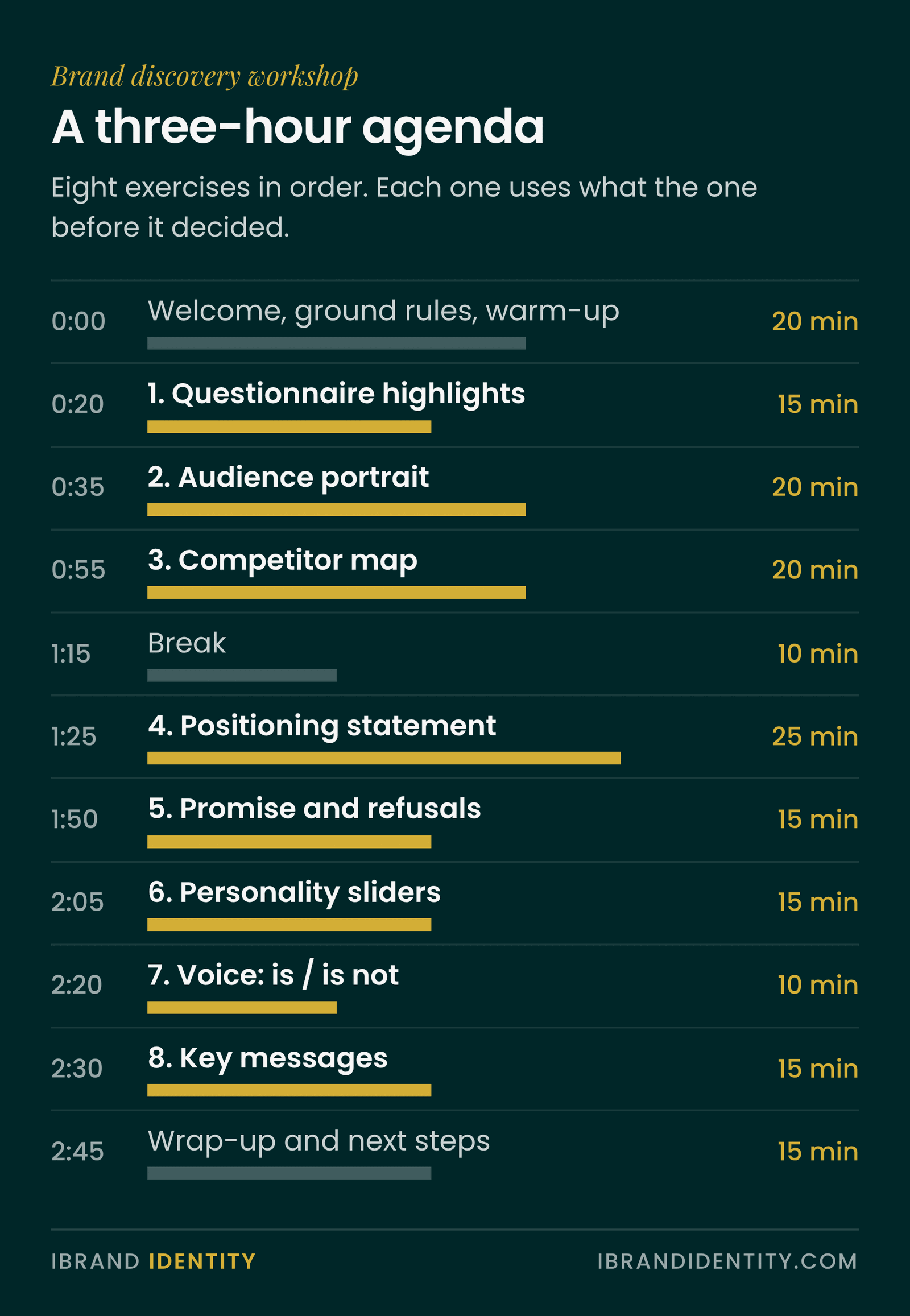
A three-hour brand discovery workshop agenda
| Time | Exercise | Length | What happens |
|---|---|---|---|
| 0:00 | Welcome and ground rules | 10 min | Goals for the session, how decisions get made, phones away. |
| 0:10 | Warm-up | 10 min | A quick, low-stakes exercise to get everyone talking. |
| 0:20 | 1. Questionnaire highlights | 15 min | Read back the strongest answers and the contradictions. |
| 0:35 | 2. Audience portrait | 20 min | One core buyer: situation, goal, fear, where they look. |
| 0:55 | 3. Competitor map | 20 min | Place three to five alternatives on two axes; find the gap. |
| 1:15 | Break | 10 min | — |
| 1:25 | 4. Positioning statement | 25 min | Draft the one sentence the brand will stand behind. |
| 1:50 | 5. Promise and refusals | 15 min | What every client gets, and what the brand won’t do. |
| 2:05 | 6. Personality sliders | 15 min | Place the brand between pairs of opposites. |
| 2:20 | 7. Voice: is / is not | 10 min | Three words it is, three it is not. |
| 2:30 | 8. Key messages | 15 min | Rank what the buyer must believe to say yes. |
| 2:45 | Wrap-up | 15 min | Read back decisions, list open questions, agree next steps. |
Adjust the times to the project, but keep the order. Each exercise uses what the one before it decided: you can’t position a brand before you know its buyer, and you can’t write its voice before you know its position.
The eight exercises
1. Questionnaire highlights
Read back three or four answers that stood out, in the client’s own words, and one or two that contradict each other. It shows you did the reading and gives the room something concrete to react to.
2. Audience portrait
Describe one core buyer on a single canvas: their situation, the result they want, the fear that stops them buying, and where they look for options. If the client names several audiences, ask which one the business would choose if it could only have one.
3. Competitor map
Draw two axes that matter to buyers, such as specialist to generalist and premium to accessible. Place three to five alternatives on the map, including doing nothing. Then ask where the client sits today and where they want to sit. The empty space is usually the conversation worth having.
4. Positioning statement
Fill in a simple frame together: For [audience] who [need], we are the [category] that [difference], unlike [alternative]. Write two or three versions and pick one. For the full format and tests, see our brand positioning statement template.
5. Promise and refusals
Agree one promise the brand can keep for every client, every time. Then list what the brand refuses to do. Refusals are where positioning becomes believable.
6. Personality sliders
Put pairs of opposites on a scale: established to disruptive, warm to exact, playful to serious, accessible to exclusive. Ask each person to place the brand, then agree one position per slider. This is where the visual direction starts.
7. Voice: is / is not
Choose three words the brand is and pair each with what it is not: confident, not loud; calm, not cold; expert, not academic. The pairs stop the words being generic.
8. Key messages
List everything the buyer must believe to say yes, then rank it. The top three become supporting messages; the first becomes the headline idea. Anything at the bottom can wait for the website.
How to facilitate well
- Ask “why?” and “for example?” The first answer is usually the polite one.
- Make people choose. When the room agrees on everything, the strategy says nothing.
- Park side topics. Keep a visible “later” list for logos, colours and website ideas.
- Protect the time boxes. A good-enough decision now beats a perfect one that eats the break.
- Write decisions where everyone can see them, so the read-back at the end is a formality, not a surprise.
Remote or in person?
Both work. In person gives you energy and side conversations; remote is easier to schedule across time zones. For remote workshops, use a shared whiteboard with the canvases set up in advance, keep cameras on, and split the session into two 90-minute blocks on consecutive days if three hours on a call is too much.
After the workshop
- Send a short recap the same day: the decisions, the open questions and the date for the strategy document.
- Write the strategy within a few days, while the conversation is fresh: insights, audience, positioning, promise, personality, voice and key messages. Our free brand strategy template gives you a nine-part structure, and our guide on how to write a brand strategy document covers the client version.
- Present it and get it signed. The signed strategy becomes the brief for the identity and the yardstick for the concept presentation.
Common mistakes
- Skipping the questionnaire. The first hour gets spent collecting facts you could have had in writing.
- Talking about logos. Visual ideas anchor the room on taste before the strategy is set.
- No decision-maker present. Everything agreed gets reopened later.
- No outputs. A great conversation with nothing written down is hard to turn into a strategy.
- Waiting weeks to write it up. Details fade fast and the client’s momentum goes with them.
A ready-made workshop
If you run discovery on every project, our Brand Discovery & Strategy Kit ($69) gives you the whole session ready to run: 18 workshop slides for a three-hour session with eight exercises, time boxes, canvases, examples and facilitation notes. It also includes the 45-question client questionnaire, a 22-slide strategy document written out as a worked example with a sign-off page, and an 8-page session guide with a timeline and three email templates.
Frequently asked questions
How long should a brand discovery workshop be?
About three hours with a break works for most small and mid-sized brands. Larger organisations with several stakeholders may need a full day or two half-day sessions. Beyond that, energy drops and decisions get worse.
Who should attend a brand discovery workshop?
The founder or final decision-maker, plus one to four people who know the customers and the business well, such as sales, marketing or operations leads. Keep it small enough that everyone speaks.
What exercises are used in a brand workshop?
Common exercises are an audience portrait, a competitor map, a positioning statement, a brand promise, personality sliders, voice words and a ranking of key messages. Each one should produce a written decision.
Can a brand discovery workshop be run remotely?
Yes. Use a shared whiteboard with the canvases set up in advance, keep cameras on, and consider splitting the session into two 90-minute blocks on consecutive days.
What happens after a brand discovery workshop?
Send a recap the same day, write the strategy document within a few days, and get it signed by the client. The signed strategy becomes the brief for the visual identity.
Should I charge for a brand discovery workshop?
Many designers charge for discovery as its own phase, because the strategy has value on its own and the preparation and write-up take real time.
Written by Martina Boshra, founder of iBrand Identity and creator of The Transmutation Method™. Brand strategist for founders and service businesses across the US, Europe and the Gulf. Part of the brand identity process guide. Last updated November 2026.